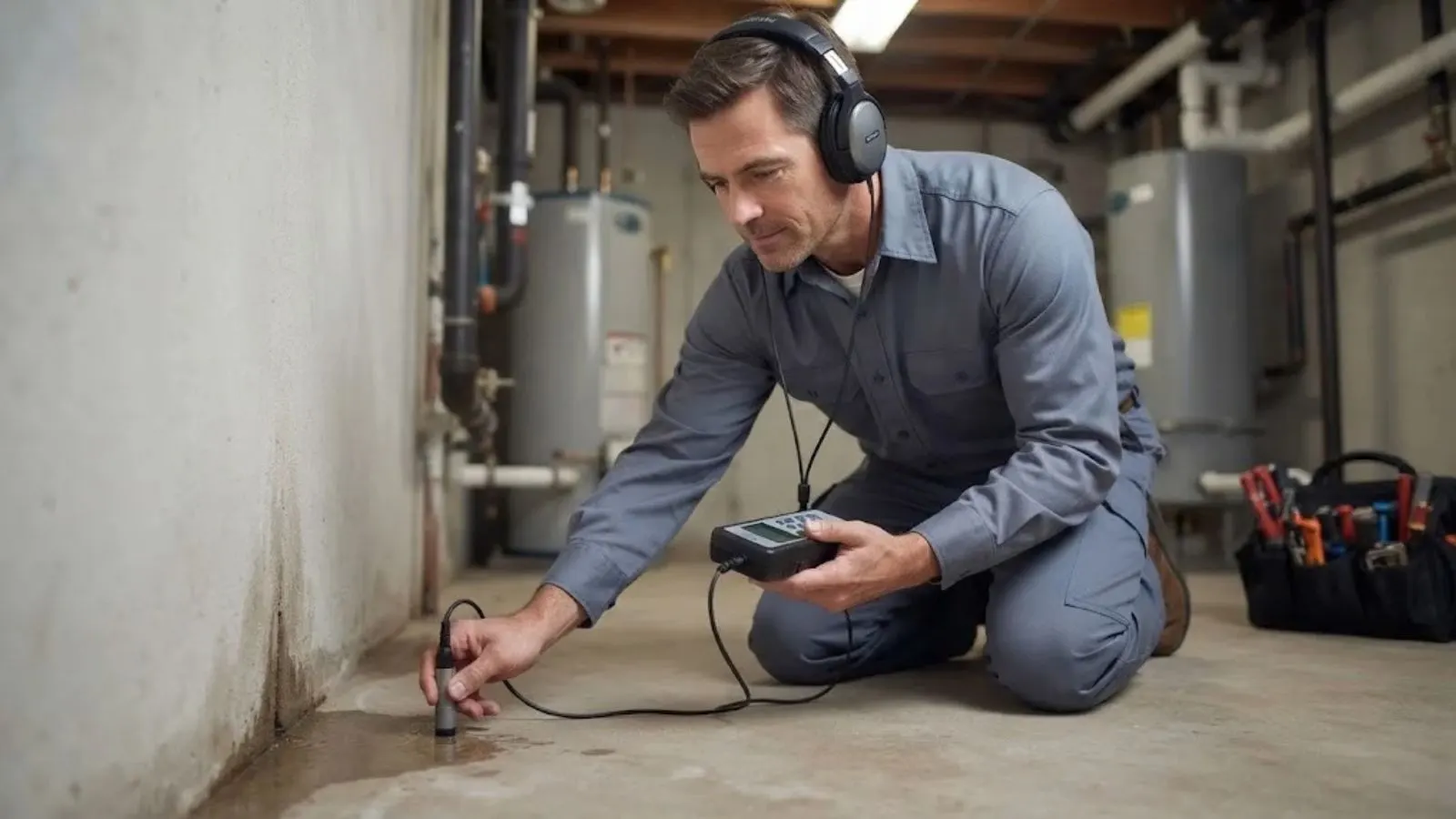
Leak detection in Woodburn, OR is the work of locating a hidden water loss without tearing the house apart. If you see water spreading, a ceiling sagging, or a meter spinning with every tap closed, treat it as urgent. Our 24/7 emergency line is open, and while you wait you can close the main shutoff valve and move anything valuable out of the wet area.
Most leaks start as a damp spot, a musty smell or a bill that creeps up. The water often travels well away from the break before it shows. A good locator narrows the trail to a few feet, and this page covers the tools, their limits and what you can check first.
When a hidden leak is an emergency
Some leaks can wait for a daytime visit. Others do damage by the hour. We take same-day appointments when available, and calls at night or on weekends reach the same emergency line.
- Water is coming through a ceiling, or the drywall is bulging or dripping.
- You hear water running inside a wall or under the floor and nothing is on.
- The floor is warm or wet over a slab.
- The yard has a soggy patch or steady trickle with no rain.
- Water is near outlets, a panel or a light fixture. Stay clear and shut off power to that area at the breaker only if you can reach it dry.
Close the main shutoff first. If the leak stops, a supply line is the cause. If it keeps going, the water may be a drain or an outside source, so tell the dispatcher which you saw.
Is your water bill a leak? Do the meter test
A bill that jumps with no change in habits is the most common reason people call us about leak detection. The City of Woodburn publishes a page called how to read your water meter, and it is the right place to learn what your dial or register shows. Then run this simple test.
- 1Stop all useTurn off every tap, appliance and the ice maker. Make sure nobody flushes during the test.
- 2Read the meterNote the small leak indicator or the last digits. Write the number down with the time.
- 3Wait 30 minutesDo not use any water. Then read it again.
- 4Compare and check toiletsIf the reading moved, water is escaping on your side of the meter. Add food coloring to each toilet tank, and if color reaches the bowl in 15 minutes, a flapper is leaking.
A flat meter with a high bill points elsewhere, such as irrigation or a longer billing period. Check the bill detail before you assume a leak.
Leak detection tools and what each one can find
No single device finds every leak. A locator picks tools by pipe location and material.
| Method | Best for | Honest limits |
|---|---|---|
| Acoustic listening | Pressurized supply lines under slabs, in walls and in the ground. A sensitive microphone picks up the hiss of escaping water. | Plastic pipe carries sound poorly. Traffic, running appliances and wind can mask a small leak. |
| Thermal imaging | Warm water in hot lines, radiant heat tubing and wet insulation. It shows temperature patterns on a surface. | It sees surface temperature only. It cannot prove a leak by itself and works poorly on cold lines. |
| Tracer gas | Small, stubborn leaks where listening fails. A harmless gas mixture is put in the emptied line and sniffed out at the surface. | Needs access to isolate and fill the pipe. Deep concrete or sealed floors can slow the gas. |
| Pressure testing | Confirms whether a line holds pressure, and which section loses it by isolating one branch at a time. | It proves a leak exists and narrows it. It does not give an exact spot. |
| Line tracing | Follows the route of a buried pipe with a transmitter so the dig starts in the right place. | It finds the path, not the leak. Metal pipe traces best and plastic usually needs a tracer wire or probe. |
| Camera inspection | Drains and sewer lines, for cracks, roots and offsets. | Supply lines are too small and pressurized for a camera, so it does not apply to them. |
Acoustic listening and thermal imaging work best when paired with a pressure test, which keeps the opening small.
Slab, ceiling, wall and crawlspace leaks
A slab leak is a supply pipe breaking under a concrete floor. Signs include a warm patch, a jump in the hot-water bill and the sound of running water with everything off. The median Woodburn home was built in 1978 (ACS 2020-2024), and older metal lines under slabs can pit from the outside. A locator listens along the floor and traces the line so a small opening is needed, not a whole room.
Ceiling and wall leaks are harder to read. Water runs along framing and drops far from the source, so the stain is rarely above the break. We check the bath above, the attic and the supply lines in that wall first. A moisture meter and thermal camera show the wet area, and a pressure test tells you whether a pipe is the cause. Roof and window leaks are not plumbing, and we will say so.
- Crawlspace: look for dripping insulation, a damp earth smell, mold on joists or a puddle below a pipe. These need a visual check and sometimes a listening device on the pipe.
- Water heater area: a slow drip at a connection can mimic a pipe leak. If it is the tank, see water heater repair.
A crawlspace leak can soak insulation and subfloor for months. If you can safely reach the main, close it while you wait.
The water service line: city side and private side
The City of Woodburn runs the public water system and the meter. The pipe from the meter to your house is the private side, and in general the owner maintains it. Ask the City where the dividing point sits for your address.
For a leak on a City main, call the City. For your own service line, the City points you to its Finance Department. After hours, a main leak goes to the Woodburn Police non-emergency line, not 911 unless it is major.
The City's October 2024 lead service line inventory covered 7,709 lines. It found no lead lines and ten unknown ones, all on one street. Many customer-side lines are galvanized steel, which rusts from the inside and causes pinhole leaks and weak pressure. If yours is galvanized and leaking, a patch may only buy time, and repiping and service line replacement is the longer fix.
Yard, meter box, irrigation and pool leaks
A wet patch in the yard, one strip of bright green grass, or a meter box that stays full suggests a buried leak. We pressure test the line, listen along its route and trace it before anyone digs. For sprinklers, we isolate each zone to see which one loses water. A backflow assembly that keeps tripping needs testing too.
Pool and spa plumbing is a separate case. A bucket test shows whether water loss is evaporation or a leak. If the pool drops faster than the bucket, the lines can be pressure tested one at a time. We test the plumbing and do not repair liners or shells.
What shapes the cost of finding a leak
We do not quote a leak detection price here because no reliable national range is published. The clear price comes before work starts, and these factors decide it:
- How many suspected areas, such as one wall or an entire house.
- Depth and material: slab, buried plastic, and accessible copper all test differently.
- How much access exists, from open crawlspace to finished tile.
- Whether you want the leak only located, or located and repaired.
- Whether the repair needs a permit through Marion County.
Insurance may help with sudden leaks and often excludes long-term seepage, so read your policy. Call (503) 974-3329 and we will walk through the scope and give a clear price before work starts.
Leak Detection questions, answered
Yes. Our 24/7 emergency line takes calls overnight and on weekends, and a licensed plumber can come out for an active leak. Shut off the main, stay away from wet electrics and give the dispatcher a short description.
Often you can narrow it to a small area first. Thermal imaging, a moisture meter and listening point to where, and a pressure test confirms a pipe is the cause. A neat access hole is usually still needed to see the pipe.
On a bare slab or open ground, a skilled locator can mark a spot within a foot or so. Deeper or sealed floors are less exact. We mark the spot and tell you how confident we are.
Only when a line under the slab cannot reasonably be rerouted. We open the smallest area we can and explain the alternatives first, including a new line through the attic or walls with new plumbing runs.
Dealing with leak detection trouble right now? A person answers the line any hour.
Call (503) 974-3329Plumbing work in Oregon is governed by the Oregon Plumbing Specialty Code, which is built on the Uniform Plumbing Code (UPC). Ask any plumber which edition and permit rules apply to your job.