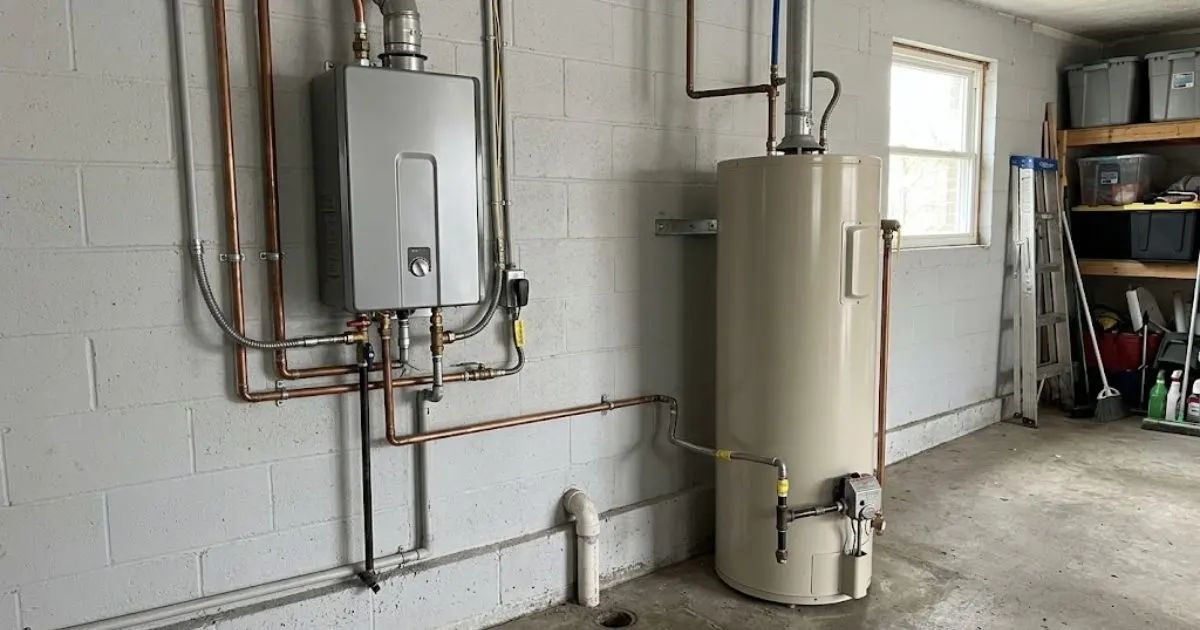
Switching from a tank to a tankless water heater in a Woodburn home comes down to what your house can feed the new unit. A tankless heater warms water as it flows, so for a few minutes at a time it needs far more gas or electric power than a tank ever does. The four things to check are the gas line size, the venting, the electric service, and the permit.
Most homes can be converted, but not always cheaply. About 55 percent of the homes in Woodburn were built before 1980, according to Census survey data, and a house from that era was usually set up for a 40 gallon tank with a small burner. Below is the order a plumber checks things in, what you can look at yourself, and the point where a licensed plumber has to take over.
Start with the gas line, because it sets the budget
A typical gas tank heater burns a modest amount of fuel and heats slowly. A whole-house tankless unit does the opposite. It fires hard, and its label often shows several times the input of the tank it replaces.
That jump is why the old gas pipe comes first. A half inch line that served a tank can be too small for a tankless burner, depending on how long the run is and what else it feeds,. A plumber doing gas and vent piping sizes the pipe using the sizing tables in the code, adds up every appliance on the line, then tells you if the pipe works as is.
The gas meter and regulator matter too. Your gas utility sets what the meter can deliver, so ask it whether the added load is fine before you order equipment.
If you ever smell gas, leave the house, do not flip switches, and call your gas utility from outside. Then call us for the plumbing side once the utility says it is safe. Our tankless water heater work starts after that check.
Venting: why the old flue usually cannot be reused
A tank heater typically vents hot exhaust up a metal flue by natural draft. Most tankless gas units are sealed and use a fan, and many run cooler exhaust that must leave through plastic or stainless pipe out a side wall or the roof. The old chimney flue is usually too large and the wrong material for that exhaust.
Condensing models also make acidic condensate, so they need a drain nearby and often a small neutralizer. The vent route has to keep the manufacturer's clearances from windows, doors and the gas meter. If the heater sits in the middle of a house, running that pipe to an outside wall can cost more than the unit.
- Garage and utility closet heaters usually have the easiest route to an outside wall.
- Interior closets and basements need longer runs and more wall penetrations.
- Manufactured homes need a model listed for them, so tell the plumber what you have.
Electric service: gas units need an outlet, electric units need a big panel
A gas tankless heater still needs household power for its fan, controls and ignition, so it needs a nearby outlet. It will not make hot water during a power cut unless you add a backup supply.
An all-electric tankless heater is a different job. Whole-house electric models can ask for several high-amp 240 volt breakers at once, and many older panels do not have the spare room. Someone has to read the heater's nameplate and your panel's open capacity before you buy. If the panel needs an upgrade, that work is a separate electrician's task and a separate cost.
What changes in the house when you go tankless
Use this as a quick scan of what a typical conversion touches.
| Item | Tank heater | Tankless conversion |
|---|---|---|
| Gas supply | Small burner, modest pipe | Larger input, pipe and meter may need upgrading |
| Venting | Natural draft flue | Sealed plastic or stainless vent, often through a side wall |
| Electric | None for most gas tanks | Outlet for gas units, large breakers for electric units |
| Permit | Required for replacement | Required, and gas or vent changes get inspected |
| Typical national price | $600 to $2,500 (Angi, HomeAdvisor) | $1,200 to $3,900 (Angi, HomeAdvisor) |
Price ranges are national figures published by Angi and HomeAdvisor, not Woodburn quotes.
How a tank-to-tankless swap runs, in order
- 1Photograph what you haveTake a clear photo of the tank's label, the gas meter, the electrical panel door and the wall nearest the heater. These four pictures let a plumber guess the scope before the visit.
- 2Check gas capacityThe plumber totals the load of every gas appliance and measures the run from the meter. If the pipe is too small, the quote includes a larger line.
- 3Choose the vent routeThe plumber picks the shortest legal path to the outside and notes any condensate drain. This is often the step that changes the price most.
- 4Confirm electric needsFor gas units, an outlet within reach. For electric units, a panel check and the breaker count the manufacturer requires.
- 5Pull the permitA water heater replacement needs a plumbing permit in Oregon, and in Woodburn those go through Marion County. Your plumber handles it, and the work is inspected.
- 6Install, then testThe old tank is drained and removed, the new unit is mounted, gas is tested for leaks, and the vent is sealed and checked. The plumber runs hot water at several fixtures and reads any error codes.
- 7Add the flush portsAsk for isolation valves on the hot and cold lines. They make the yearly flush a ten minute job instead of a service call.
What the switch costs, from published ranges
Angi puts a national tankless water heater replacement at about $1,200 to $3,500. HomeAdvisor lists about $1,400 to $3,900 installed. For comparison, both sites show a standard tank replacement at roughly $600 to $2,500.
Those are national figures, not Woodburn quotes and not our prices. The gap between the low and high end is mostly the work around the heater: a bigger gas line, a new vent, a drain, or a panel upgrade. A conversion in a house that already has a short gas run and an outside wall behind the heater lands near the low end.
We give a clear price before work starts, after we have seen the gas meter, the vent route and the panel. Call (503) 974-3329 and ask for a site check. We make that trip to Woodburn homes and to nearby Gervais, about 4 miles away, and Silverton, about 11 miles away.
Woodburn local note: permits go through Marion County
Plumbing permits and plumbing inspections inside Woodburn are issued and done by Marion County, not by the City. The City's design standards page lists Marion County at (503) 588-5036 for electric and plumbing. Confirm the number before you call, since city and county phone lines can change.
Oregon's Building Codes Division says a water heater replacement requires a permit, and a licensed contractor may use a minor label for that kind of job. Plumbing work in Oregon is covered by the 2023 Oregon Plumbing Specialty Code, based on the 2021 Uniform Plumbing Code. Confirm the details of your project with the building department.
A gas tankless unit also needs power. The February 2021 ice storm left hundreds of thousands of people in the Northwest without electricity, with outages peaking on Saturday, February 13. In a storm like that, a gas tankless heater with no backup supply makes no hot water, while some tank heaters with a standing pilot keep working.
Scale is the long-term cost of a tankless heater
Minerals in water leave scale on a tankless heater's heat exchanger, and many manufacturers call for a periodic flush with a pump and a mild acid. How fast it builds depends on the water. No hardness number for Woodburn has been published in the city's water reports we found, so test your tap with a simple kit and ask the City for its annual water quality report.
Skipped flushes usually show up first as an error code or weak hot water flow.
Questions about this topic
Sometimes. It depends on the pipe diameter, the length of the run, the other appliances on the line, and what the meter can supply. A plumber totals the load and checks the pipe against the sizing tables before quoting.
Oregon requires a plumbing permit to replace a water heater, and Marion County handles plumbing permits and inspections inside Woodburn. A licensed plumber pulls it for you. If gas, venting or electrical work is added, those are covered in the same project.
A gas tankless heater needs electricity for its fan and controls, so it stops when the power goes out. A small battery backup or generator connection can keep it running. Ask about that before you choose a unit if your area loses power in storms.
Possibly, but the unit must be listed for use in manufactured homes, and the vent and gas connections follow special rules. About 7 percent of Woodburn's housing units are mobile homes, so tell the plumber what you have when you call.
No hardness figure for Woodburn is published in the city reports we reviewed. The City treats its groundwater to remove iron and manganese, but scale depends on minerals in your tap. Test your water and plan on a yearly flush through isolation valves.
Dealing with this at home right now? Call any hour and a person picks up.
Call (503) 974-3329Guidelines here are general. The Oregon Plumbing Specialty Code, based on the UPC, and the manufacturer's instructions decide what is allowed on your job.