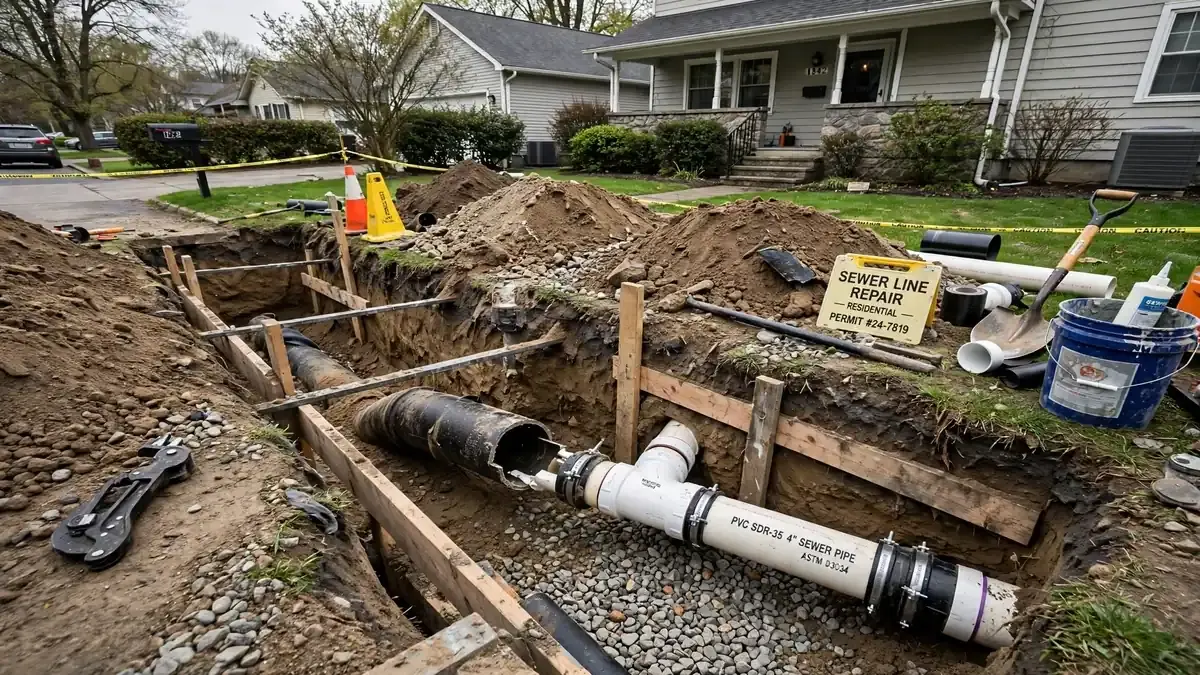
A broken sewer line can leak sewage into the soil under your yard or house, or collapse enough to back waste into your fixtures. If sewage is coming up now, call our 24/7 emergency line, stop using water, and keep everyone out of the wet area until we arrive. We handle sewer line repair in Woodburn, OR, with same-day appointments when available.
Repair means fixing the damaged part of the pipe that carries waste from your house to the city sewer. The right fix can be a short spot repair, a liner installed through the pipe, or a full replacement. The camera picture decides which, and we explain the options before we pick up a shovel.
Signs the sewer line is damaged, not just clogged
A clog clears and stays clear. A damaged pipe keeps coming back. These signs point to a break, a sag or a root-split joint.
- Backups that return every few weeks or months, even after cleaning.
- A sewer smell in the bathroom or yard that does not go away.
- A soft, sunken or unusually green strip of lawn along the pipe path.
- Gurgling fixtures and floor drains that bubble after a flush.
- Cracks in a slab or foundation near where the line leaves the house.
- A camera that shows water standing in a low spot in the pipe.
If any of these match, call (503) 974-3329. We usually begin with a camera inspection so the repair is based on what the pipe looks like and not a guess.
Spot repair, lining or replacement
Three methods cover most sewer repairs. Which one fits depends on how much of the pipe is bad and how it is damaged.
| Method | Best when | Trade-offs |
|---|---|---|
| Spot repair | One cracked, offset or root-split section with sound pipe on both sides | Needs a dig at that spot, but is the smallest job and often the least expensive |
| Trenchless lining | Long runs with cracks or small joint gaps, pipe still round | Little digging, but does not fix a collapse or a deep sag |
| Pipe bursting or full replacement | Pipe is crushed, badly sagging, or failing in many places | Highest cost, the longest fix, and the most lasting result |
General trade guidance. A camera and a locator decide which method fits your line.
Cast iron, clay and other older pipe
Homes built in the 1960s and 1970s commonly have cast iron or early plastic drains, and some older lots have clay tile outside. Cast iron rusts from the inside, builds rough scale and eventually flakes or cracks. Clay tile joints open slowly and let roots in.
Woodburn's housing makes this relevant. The Census Bureau's survey puts the median build year at 1978, with about 11 percent of homes built before 1960. A house in that older group is more likely to have a clay or cast iron lateral that has aged out.
If your pipe is cast iron, ask the plumber to show you the camera image of the scale. It will tell you if cleaning will help or if the pipe is close to done. Be careful of anyone who recommends a full replacement without showing you the footage.
When sewage is surfacing because the pipe failed
If sewage is surfacing, stop all water use at once. Keep children, pets and bare feet away from the wet floor, and do not run a wet-dry vacuum in standing sewage. Our 24/7 emergency line takes after-hours repair calls on nights and weekends, and we book same-day appointments when available.
Tell us where the water is showing up, and whether other fixtures have slowed. For a general backup, our sewer line cleaning page describes the first-response steps, and a repair visit often starts with that cleaning so we can see the pipe.
Roots in the sewer line
Roots do not break a healthy pipe. They find an open joint or a hairline crack, push in, and grow into a mat that blocks the line. Cutting the roots restores flow, but if the opening stays, they return, sometimes within a year.
That is the reason repair beats repeated cleaning once the camera shows a split joint. A spot repair or a liner seals the entry point. If the roots are the only problem, a cleaning with a cutting nozzle through hydro jetting may be enough for a time.
Winter rain in the mid-valley area runs near 40 inches a year at Salem, and soil stays wet for months. Roots chase that water into pipes, so slow drains in January and February are a hint to scope the line.
City sewer or septic outside city limits
Homes inside Woodburn are connected to the City's sewer system, and your repair stops at the point where your pipe meets the city connection. Rural properties around Marion County often use a septic tank and drain field instead, where the repair path includes the tank and field. Tell us which you have when you call so we send the right plan. We also take repair calls in Silverton, about 11 miles from our Woodburn address.
Permits and who does the work
Plumbing permits and inspections in Woodburn go through Marion County. Ask the county building office whether your sewer repair needs a permit, since rules vary with the work. Repairs follow the Oregon Plumbing Specialty Code, which is based on the Uniform Plumbing Code.
Plumbing work in Oregon requires both a Construction Contractors Board license and a plumbing contractor license from the Building Codes Division, and you can check both on the state's license search. We are licensed and insured.
What drives the price of a sewer repair
HomeAdvisor publishes a national range of about $1,388 to $5,323 for sewer main repair, with an average near $3,319. Bob Vila, citing similar data, lists lining at about $80 to $250 per foot and pipe bursting at about $60 to $200 per foot. These are national figures, not Woodburn quotes and not our prices.
The clear price comes before work starts. Call (503) 974-3329 and we will talk through your camera findings.
- How many feet of pipe are damaged and how deep the pipe runs.
- Whether the damage allows lining or needs a dig.
- What sits above the pipe, such as a driveway, a patio or a tree.
- Whether a cleanout must be added or fixed.
- Whether the job is urgent and needs an after-hours start.
Insurance coverage for sewer damage varies by policy and often excludes pipe wear. Check yours before you assume it will pay.
Sewer Line Repair questions, answered
Yes. The 24/7 emergency line is answered every night, weekend and holiday. We book same-day appointments when available and give you a clear price before work starts.
Often, yes. If the camera shows one bad section and the rest of the pipe is sound, a spot repair costs less and disturbs less ground. Several breaks or a long sag usually push the answer toward lining or replacement.
Lining and bursting are the trenchless options, and each suits certain pipe conditions. A camera and a locator tell us whether yours qualifies. A crushed pipe usually cannot be lined.
A spot repair is often a one-day job once the pipe is located. A long replacement may take a couple of days, depending on depth and what sits above the line. We give you a timeline with the price.
Yes. A camera with a locating transmitter lets us trace the path above ground and mark the spot and depth of any problem.
Yes. A recorded camera look before closing shows roots, sags and breaks, and it gives you facts for negotiating a repair. See the sewer inspection page for how that works.
Dealing with sewer line repair trouble right now? A person answers the line any hour.
Call (503) 974-3329Plumbing work in Oregon is governed by the Oregon Plumbing Specialty Code, which is built on the Uniform Plumbing Code (UPC). Ask any plumber which edition and permit rules apply to your job.