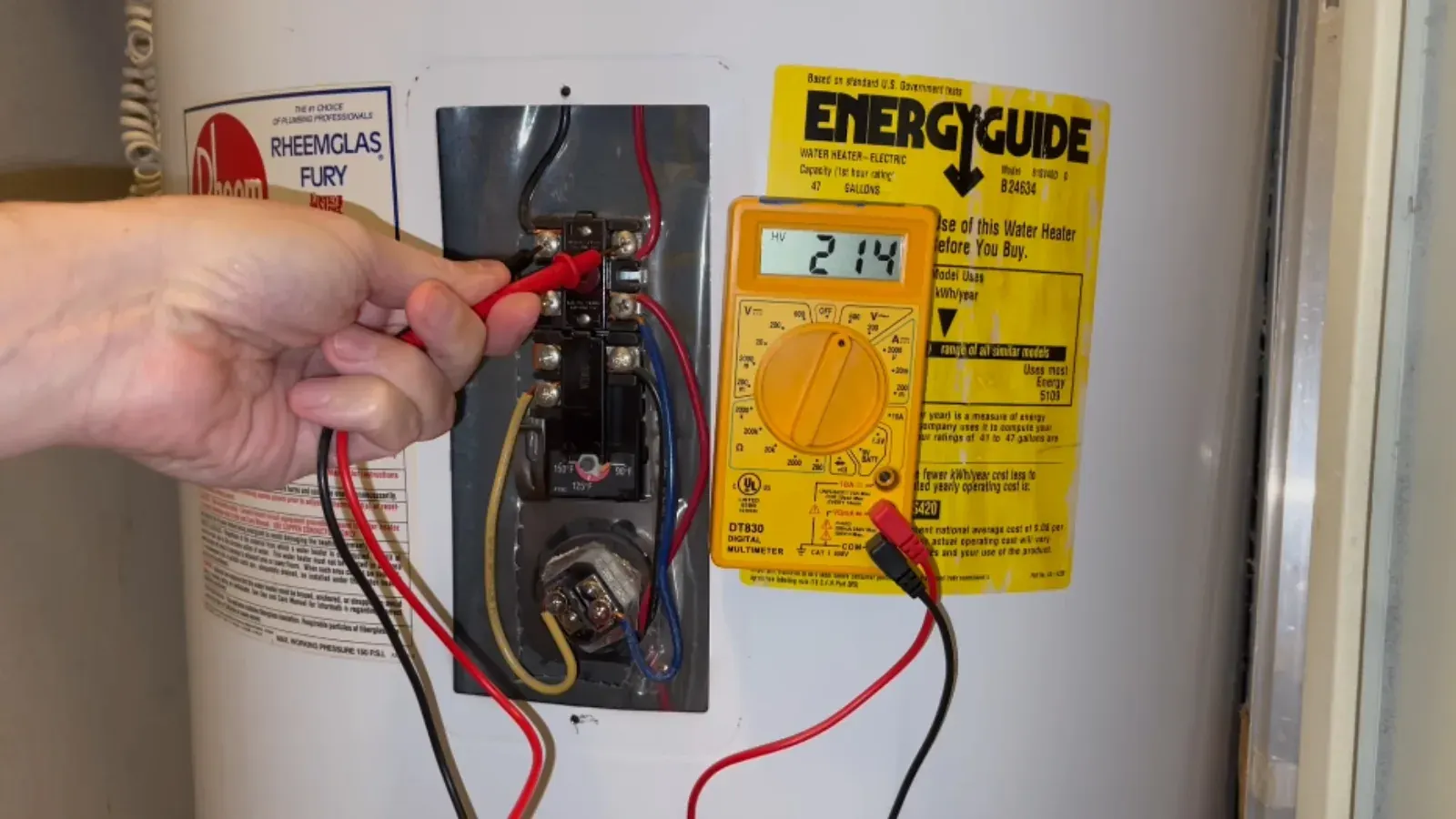
An electric tank water heater has two thermostats, one upper and one lower, each hidden behind a metal panel on the side of the tank. Replacing one means turning off the power, removing the panel and insulation, swapping a small switch that controls a heating element, and testing it. The parts cost little, but the wiring carries 240 volts, which can kill.
If you are not comfortable proving a circuit dead with a meter, do not start. Call (503) 974-3329 and a licensed plumber can find out whether the thermostat is the problem at all. Here is the full process, the safety rules, and what to set the temperature to when you are done.
Electrical safety comes first
Turning off the heater's breaker is the first step, not the last. Water heaters on 240 volt circuits use a two pole breaker, and a mislabeled panel can leave a live wire in the heater. You must confirm that power is off at the thermostat itself before you touch anything inside the access panel.
Use a non-contact voltage tester first, then a multimeter on the wires. If you are unsure of any step, stop. Do not work on the heater while standing in water, and do not touch the tank or pipes with a wet hand while the panel is open.
Is it really the thermostat? Check these first
Several problems look the same as a bad thermostat. Check these before buying a part.
- The breaker has not tripped, and the high limit reset button on the upper thermostat is not popped
- Water is lukewarm or runs out fast, which can point to a failed lower element
- Water is scalding or the relief valve keeps dripping, which can mean a stuck thermostat or a high limit failure
- Water runs out quickly, which may be a broken dip tube or sediment, not the thermostat
- Both elements test with a meter for continuity, since an element can fail and mimic a thermostat problem
A no hot water call can come from the thermostat, element, breaker, wiring or the tank itself. If the tank is leaking, the thermostat is not the issue, and our water heater replacement team can look at whether the tank has reached the end of its life.
Replace the thermostat step by step
You will need a screwdriver, a non-contact voltage tester, a multimeter, needle nose pliers, a camera phone and the right replacement thermostat for your model. Never power the heater unless the tank is full of water.
- 1Turn off the breakerSwitch the two pole breaker for the water heater off at the main panel and put tape over it. Tell everyone in the house not to turn it on.
- 2Confirm the power is deadRemove the metal access panel, fold back the insulation, and remove the plastic cover. Test the terminals with a non-contact tester, then a meter, before touching a wire.
- 3Photograph the wiringTake a clear photo of every wire and its terminal. The upper thermostat has a different layout from the lower one.
- 4Disconnect the old thermostatLoosen the terminal screws, pull the wires off, and slide the old thermostat out of its clip. Note which one is upper and which is lower.
- 5Clip in the new thermostatPress it flat against the tank wall, since the sensor needs full contact with the metal. A gap here causes inaccurate temperature.
- 6Reconnect the wiresAttach each wire to the matching terminal from your photo and tighten firmly. Loose terminals overheat.
- 7Set the temperatureSet both thermostats to the same value, usually 120 degrees Fahrenheit, and make sure the high limit reset button is pushed in.
- 8Close up and restore powerReplace the insulation and covers, make sure the tank is full, then turn on the breaker. Check for heat after a couple of hours.
Scald-safe temperature settings
The thermostat setting is a safety choice, not just a comfort one. Hotter water burns skin faster, especially for children and older adults.
| Setting | What it means | Notes |
|---|---|---|
| 120 degrees Fahrenheit | A common safe default for homes | Lowers scald risk, and often saves energy |
| 130 to 140 degrees | Hotter water for dishwashers or large families | Serious scald risk in seconds, so use mixing valves |
| Below 120 degrees | Can encourage bacteria growth inside the tank | Not advised unless a plumber recommends it |
| Different upper and lower settings | Tank heats unevenly | Set both thermostats to the same number |
Check the manufacturer's label on your water heater and ask a plumber about anyone in your household with health concerns.
What a plumber or electrician should handle
Some jobs go past a simple thermostat swap. Hand these off: burned or melted wires, a scorched terminal, a breaker that trips again right after you reset it, or any sign of water inside the panel. Those point to an element short, a bad connection or a wiring problem, and the answer is not a new thermostat.
Call a plumber if the tank leaks, rumbles loudly or has old scale buildup, and call an electrician if the circuit or breaker is at fault. Our water heater repair team can test the elements and the controls on site, then tell you what is bad before you spend money on parts.
- Burned, melted or discolored wiring
- A breaker that trips on every reset
- Water in the thermostat compartment
- Hot water that is scalding even with the setting turned down
- A tank that is leaking or corroded
Woodburn local note: permits and code for water heater work
Oregon's Building Codes Division says a permit is required to replace a water heater, and a contractor may use a minor label. Replacing a thermostat inside an existing heater is not listed as a permit item on that page, but ask Marion County to confirm, since Marion County issues plumbing permits and inspections inside Woodburn.
The code in force is the 2023 Oregon Plumbing Specialty Code, based on the 2021 Uniform Plumbing Code. Plumbing work needs both a CCB license and a BCD plumbing contractor license, and you can check any contractor on the state license search before you hire.
Cost and when replacing the heater makes more sense
A thermostat is an inexpensive part, but the total depends on whether the problem is the thermostat, an element or something else. A professional visit adds a diagnosis, which is often worth it when you are not sure. Angi and HomeAdvisor publish a national range of about $600 to $2,500 to replace a tank heater, which is the figure to weigh against repairs on an old unit.
Those are national numbers and not Woodburn quotes. Call (503) 974-3329 and we give a clear price before work starts. We also serve Hubbard, about 4 miles from our Woodburn address, and Silverton, about 11 miles away, with same-day appointments when available.
Questions about this topic
If there is no hot water at all, the upper thermostat or high limit is the usual suspect, since the upper one powers up first. If water is only lukewarm or runs out quickly, the lower thermostat or lower element may be the cause. A meter test confirms it.
120 degrees Fahrenheit is a common safe setting and it reduces scald risk. Set both the upper and lower thermostats to match.
Many homeowners do, as long as they can prove the power is off with a tester and a meter. Oregon's Building Codes Division does not list thermostat replacement as a permit item, but confirm with Marion County. If you are unsure, call a plumber or electrician.
The high limit switch trips when the water gets too hot. A repeat trip can mean a failed thermostat, a stuck element or a wiring fault, and you should not keep resetting it. Turn off the breaker and call a professional.
No. A thermostat sits on the outside of the tank, so you do not drain it. You do need the tank full before you restore power, since heating elements burn out quickly when dry.
Dealing with this at home right now? Call any hour and a person picks up.
Call (503) 974-3329Guidelines here are general. The Oregon Plumbing Specialty Code, based on the UPC, and the manufacturer's instructions decide what is allowed on your job.